What Makes a Veterinary Doctor “Certified” — A Delhi Pet Owner’s Guide
If you’ve ever typed “book vet home visit online Delhi” into Google at 11 pm because your housemate wouldn’t stop scratching its ear, you already know the panic of not knowing who’s actually going to show up at your door. Is this person even a real vet? Do they know what they’re doing? That worry is fair — and it’s exactly why understanding what “certified” actually means can save you a lot of stress the next time you’re booking help in a hurry.
Most pet owners assume any vet clinic listed online is automatically qualified. But the term “certified veterinarian” has a real, specific meaning in India, and knowing it helps you tell a genuine professional apart from someone who’s just good with pets.
What “Certified” Actually Means for a Vet in India
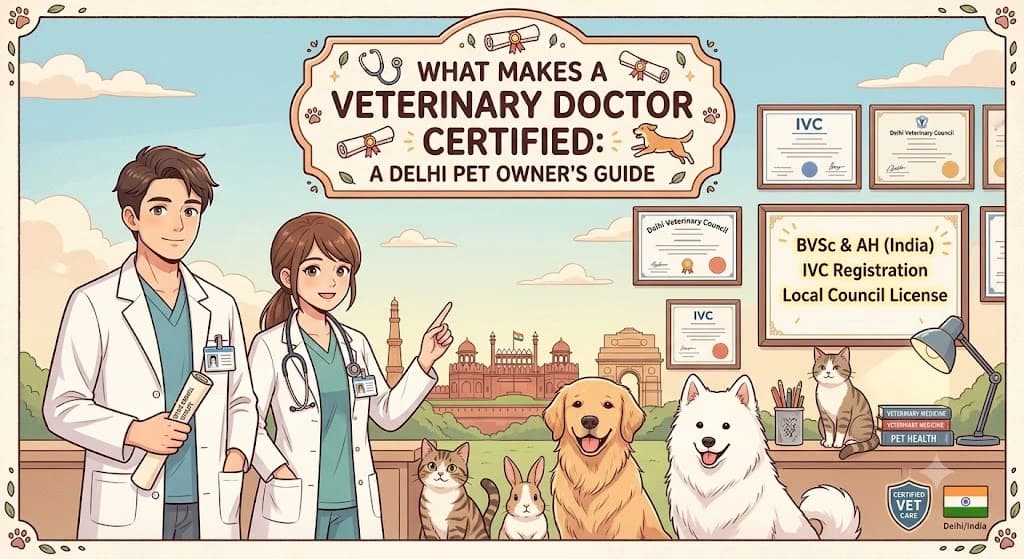
In India, a certified veterinary doctor is qualified as a Bachelor of Veterinary Science and Animal Husbandry (B.V. Sc & AH) from a recognized university, after which they need to be registered with the Veterinary Council of India or their State Veterinary Council. This is nothing less than a license that enables you to prescribe medicines for your pet and provide other basic treatment or diagnose issues.
Think about it this way.
Would you allow just anyone to give you injections, prescribe antibiotics, and recommend treatment? So, apply the same logic here too. A certified vet has gone through years of clinical practice, undergone supervised training, and cleared the licensure exams that establish that they’re well-versed with surgery, anatomy, emergency treatment, and medicine. They’re more than just a textbook reading cut-out with a stethoscope.
Some of them get advanced certification in special areas like dermatology, orthopedics, or internal medicine, but having your vet registered with the council is the definite minimum.
If the clinic or the vet themselves can’t provide you this proof, you’d better think long before letting your fur buddy and housemate be treated there.
Why This Matters More When You’re Booking a Home Visit
Here’s the thing about a home visit — you’re inviting someone into your space to handle a sensitive, sometimes urgent situation, often without the backup of a full clinic around them. That makes their actual qualifications even more important, not less.
A lot of pet owners in Delhi and the surrounding areas now prefer a vet home visit in Delhi NCR simply because it removes the stress of travel — no carrier struggles, no waiting rooms full of anxious dogs, no traffic jams with a sick housemate in the back seat. But convenience shouldn’t come at the cost of quality. A home-visit vet still needs the same registration, the same clinical judgment, and ideally the same access to basic diagnostic tools that a clinic-based vet would have.
I remember a friend in Vasant Kunj who booked a random home-visit number she found on a classifieds app because her cat wasn’t eating. Turned out the “vet” was actually a vet technician who couldn’t legally prescribe anything and had to reschedule everything through an actual doctor anyway — wasting a full day her cat didn’t really have to spare. That’s the exact scenario proper verification avoids.
How to Actually Check Before You Book
You don’t need to interrogate anyone, but a few quick questions go a long way:
Ask for their Veterinary Council registration number. A legitimate professional will share this without hesitation — it’s public information anyway.
Check if the platform or service lists its vets’ qualifications upfront. Reputable services that offer a veterinary doctor at home Delhi option usually display this clearly on their website or booking page, because they know pet owners are looking for exactly this kind of reassurance.
Notice how they talk about your housemate’s symptoms. A properly trained vet will ask follow-up questions — appetite changes, duration, any recent diet shifts — rather than jumping straight to a diagnosis over the phone.
If it’s a genuine emergency, ask whether they carry basic equipment for on-the-spot assessment, like a stethoscope, thermometer, or wound-care kit. Home visits work best when the vet is actually equipped to handle what they find, not just there to “take a look.”
What a Good Home Visit Actually Looks Like
A well-run visit usually starts with the vet asking about your housemate’s history before they even open their bag — past illnesses, vaccination records, any ongoing medication. Then comes a physical check: temperature, heart rate, gum color, that sort of thing. If needed, they’ll explain what tests or follow-ups make sense, rather than pushing unnecessary procedures.
What you shouldn’t accept is vague answers, rushed visits, or someone who seems unsure about basic terminology. Your housemate can’t tell you when something’s off with the person treating them, so that judgment call is entirely on you.
For routine stuff — vaccinations, deworming, general checkups — home visits are honestly a great option. You skip the commute, your housemate stays calmer in a familiar space, and appointments tend to run on time since there’s no clinic backlog to deal with. It’s part of why so many people across the city now search to book vet home visit online Delhi rather than default to the nearest clinic.
A Quick Note on Trust
Certification isn’t just paperwork — it’s the difference between someone guessing and someone who actually knows what they’re looking at. Delhi has no shortage of pet care options these days, which is great, but it also means a bit more due diligence falls on you as the owner.
The good news is that this check takes maybe two minutes. A registration number, a quick look at reviews, a sense of how the vet communicates — that’s usually enough to know you’re in good hands.
Your housemate trusts you to make the right calls for them. Taking those two extra minutes before you book is really just you keeping up your end of that trust.